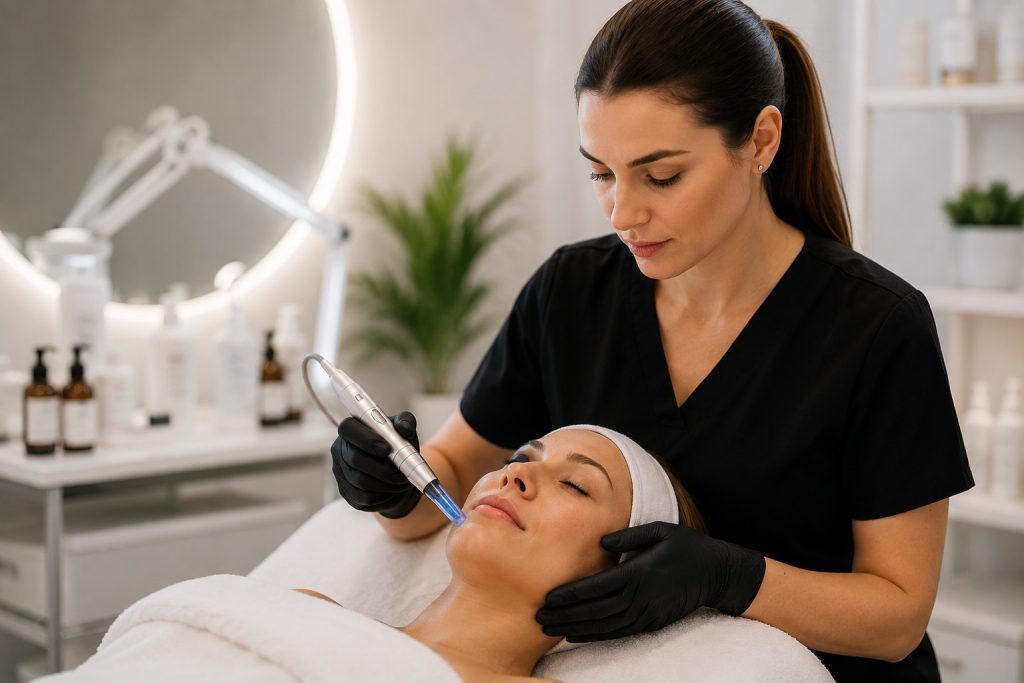
A medical degree is not the only route into professional skin and aesthetics practice.
Many successful practitioners begin their careers in beauty therapy, skincare or vocational aesthetics rather than medicine or nursing. However, this does not mean that every Level 4 qualification is open to someone with no previous education or industry experience.
A level 4 aesthetics course for non medics can provide a recognised route into advanced skin treatments, but applicants must still meet the qualification’s entry requirements. They must also understand an important distinction: completing Level 4 does not make someone a doctor, nurse or regulated healthcare professional, nor does it automatically permit them to perform every aesthetic procedure.
For eligible learners, Level 4 represents a significant professional step. It develops advanced skin knowledge, consultation skills and practical competence, helping practitioners move beyond introductory beauty treatments and towards evidence-informed aesthetic practice.
At DRV London Academy, students can study a regulated Level 4 aesthetics course in London as part of a structured pathway extending from Level 3 to advanced Level 7 education.
Can a Non-Medic Study Level 4 Aesthetics?
Yes. A non-medic can study a level 4 aesthetics course, provided they meet the relevant entry requirements.
In this context, a non-medic is generally someone who is not registered as a doctor, nurse, dentist, pharmacist or another statutory healthcare professional. It does not necessarily mean that the applicant has no beauty, skincare or aesthetics background.
The ProQual Level 4 Diploma in Aesthetic Treatments and Skin Science is a regulated qualification numbered 610/4475/1. ProQual describes its aesthetics qualifications as a progression pathway beginning with foundation learning at Level 3 and continuing through Levels 4, 6 and 7.
Therefore, applicants may include:
- Qualified beauty therapists
- Skincare practitioners
- Aestheticians with relevant experience
- Level 3 aesthetics graduates
- Experienced beauty professionals
- Eligible non-medical practitioners seeking regulated progression
The essential issue is not whether an applicant is a medic. It is whether they possess the required foundation knowledge or verifiable professional experience.
What Are the Entry Requirements?
The current ProQual qualification information identifies the programme as a Level 4 diploma with 635 hours of Total Qualification Time and 442 Guided Learning Hours. It is assessed on a pass-or-fail basis, with assessment completed internally by an approved centre and externally quality-assured by ProQual.
ProQual’s published catalogue states that applicants must be at least 18 years old and meet a relevant prior-learning or professional-experience requirement. Its supporting qualification materials refer to a suitable Level 3 foundation or substantial verifiable experience within the beauty industry.
In practical terms, an applicant will normally need to demonstrate one of the following routes:
A Relevant Level 3 Qualification
This may include the ProQual Level 3 Diploma in Pathway to Aesthetic Practice or an accepted equivalent qualification.
The Level 3 route establishes knowledge in areas such as:
- Anatomy and physiology
- Skin structure and function
- Health and safety
- Infection prevention
- Consultation
- Contraindications
- Professional conduct
Students who do not yet hold an appropriate prerequisite can explore the Level 3 aesthetic course at DRV London Academy before applying for Level 4.
Verifiable Beauty Industry Experience
Some experienced applicants may be considered through an experience-based route.
Published ProQual materials refer to five years of verifiable experience within the beauty industry as an alternative entry route. Evidence may include employment records, treatment portfolios, professional references, qualifications, insurance records or other documentation demonstrating genuine industry practice.
The training centre must assess and document whether an applicant satisfies the entry criteria. Experience should not simply be claimed; it must be capable of verification.
Is Level 4 Suitable for Complete Beginners?
Not normally as a direct starting point.
A person can be a non-medic and still be fully eligible for Level 4. However, a complete beginner with no relevant qualification, anatomy and physiology education or industry experience would usually need to establish the appropriate foundation first.
This is precisely why the Level 3 pathway exists.
ProQual describes its Level 3 aesthetics diploma as knowledge-based preparation for entry into aesthetic practice. The Level 4 diploma then develops more advanced treatment and skin-science competencies.
A beginner should not view Level 3 as an unnecessary delay. Foundation learning supports the judgement required at Level 4, where students are expected to understand:
- How the skin functions
- Why contraindications matter
- How to assess treatment suitability
- How to recognise abnormal presentations
- How to prevent infection
- How to plan and document treatments
- When treatment should be declined or postponed
Attempting advanced practical work without this knowledge may leave substantial gaps in competence.
What Is the ProQual Level 4 Diploma?
The qualification’s official title is the ProQual Level 4 Diploma in Aesthetic Treatments and Skin Science.
Its qualification number is 610/4475/1. ProQual presents it as a nationally recognised qualification for practitioners seeking to develop advanced knowledge and practical skills within skin and aesthetics.
The diploma is broader than an isolated one-day treatment certificate. It combines scientific understanding, professional principles, consultation and practical treatment assessment.
The qualification structure includes five mandatory units and a minimum of four optional units. The exact optional-unit combination delivered by a centre should always be confirmed before enrolment.
This distinction matters. Two academies may both advertise the same Level 4 diploma while delivering different permitted combinations of optional units.
Before enrolling, ask for:
- The complete unit list
- Which units are mandatory
- Which optional units the academy delivers
- The number of practical assessment days
- Model and portfolio requirements
- The expected completion period
- The exact certificate title
- The awarding organisation and qualification number
What Will You Learn During Level 4?
The DRV London Academy course page places particular emphasis on skin science, consultation, microneedling and chemical peel education. It also lists wider potential treatment units within the qualification structure.
The principal areas of learning include the following.
Health and Safety
Students develop their understanding of safe working practices within a salon, academy or aesthetic treatment environment.
This includes maintaining an appropriate treatment space, using personal protective equipment correctly and reducing preventable risks to clients and practitioners.
Infection Control
Aesthetic treatments may compromise the skin barrier, use needles or involve close contact with treatment areas.
Students must therefore understand:
- Hand hygiene
- Cross-contamination prevention
- Cleaning and disinfection
- Equipment handling
- Sharps safety where relevant
- Clinical waste
- Personal protective equipment
- Treatment-room preparation
Infection control is not an administrative formality. It is part of competent treatment delivery.
Anatomy, Physiology and Pathology
Level 4 develops the learner’s understanding of the structures and systems relevant to aesthetic treatment.
Students must be able to distinguish between normal variation, treatment contraindications and presentations that may require medical referral. They are not trained to diagnose medical conditions, but they should recognise when a treatment falls outside their competence.
Skin Science
A level 4 skin course should teach more than how to follow a product protocol.
Learners need to understand:
- Skin structure and barrier function
- Wound-healing responses
- Pigmentation
- Ageing
- Inflammation
- Skin types and conditions
- Treatment response
- Post-treatment recovery
This knowledge supports safer treatment selection and more realistic client expectations.
Consultation and Treatment Planning
A professional consultation is a clinical decision-making process, not merely a sales conversation.
Students learn to consider:
- Medical and treatment history
- Current medication
- Allergies and sensitivities
- Previous reactions
- Skin condition
- Contraindications
- Client expectations
- Treatment alternatives
- Aftercare
- Informed consent
Good consultation protects both the client and the practitioner.
Does Level 4 Include Microneedling?
Microneedling is listed within the DRV London Academy Level 4 course content and within the wider ProQual qualification structure.
Training should address more than device operation. Learners need to understand:
- Appropriate client selection
- Skin preparation
- Needle depth and treatment planning
- Contraindications
- Infection prevention
- Treatment technique
- Expected skin response
- Post-treatment care
- Potential complications
- Accurate treatment records
Whether a graduate can obtain insurance to perform microneedling will depend on the exact unit completed, successful practical assessment and the insurer’s acceptance criteria.
Students should confirm insurance eligibility before paying for any course.
Does Level 4 Include Chemical Peels?
Chemical peel treatment is also included within the qualification options and highlighted by DRV London Academy as a principal area of practical education.
Chemical peel training should include:
- Skin assessment
- Peel selection
- Acid strength and formulation
- Preparation and application
- Timing and neutralisation
- Contraindications
- Fitzpatrick skin considerations
- Pigmentation risk
- Aftercare
- Managing adverse responses
A practitioner should never select a peel solely according to the client’s requested result. Treatment choice must reflect the client’s skin, history, risk factors and ability to follow aftercare instructions.
What Other Treatments May Be Included?
The wider ProQual diploma allows centres to select from a range of optional treatment units. Published examples include microneedling, chemical peels, dermaplaning and non-surgical approaches to selected skin blemishes. Other optional routes may also be available within the complete qualification specification.
The DRV course page currently lists a broader collection of units, including:
- Microneedling
- Chemical peels
- Dermaplaning
- Plasma pen treatments
- Cosmetic micropigmentation
- Microblading
- Scalp micropigmentation
- Selected non-surgical skin-blemish procedures
However, students should not assume that every listed treatment is automatically included within every enrolment.
Ask DRV London Academy to confirm the exact mandatory and optional units attached to the programme you are booking.
Does Level 4 Make You a Medical Practitioner?
No.
Completing a level 4 aesthetic practitioner course does not confer medical registration, prescribing rights or protected healthcare status.
A Level 4 graduate remains responsible for working within:
- The scope of their qualification
- Their demonstrated practical competence
- Their insurance coverage
- Product and device instructions
- Applicable local authority requirements
- Current legislation
- Appropriate referral boundaries
A non-medical practitioner should never imply that they are a doctor, nurse or other regulated healthcare professional unless they separately hold that registration.
Professional credibility comes from being clear about your role—not attempting to make it appear broader than it is.
Can You Obtain Insurance After Level 4?
Potentially, but insurance is never automatic.
Insurers assess practitioners according to factors that may include:
- The awarding organisation
- The exact qualification
- Units completed
- Practical assessment
- Previous experience
- Treatment type
- Products and equipment
- Claims history
- Premises
- Working arrangements
An Ofqual-regulated qualification may be viewed more favourably than a brief attendance certificate, but every insurer sets its own acceptance criteria.
Before enrolling, contact prospective insurers and provide:
- The complete qualification title
- Qualification number 610/4475/1
- The treatment units you expect to complete
- Your current qualifications and experience
- The academy delivering the programme
Request written confirmation wherever possible.
Do not assume that a general Level 4 certificate provides cover for treatments that were not taught and practically assessed.
What Can You Do After Completing Level 4?
Successful completion can support several professional directions, depending on the units achieved and insurance obtained.
Graduates may use the qualification to:
- Offer assessed skin treatments
- Work within an established salon or aesthetics clinic
- Expand an existing beauty treatment portfolio
- Develop a skin-focused practice
- Build practical experience
- Progress into higher qualifications
- Strengthen their professional documentation
The qualification should be treated as a platform for continued development.
A responsible practitioner continues reviewing protocols, completing further education, documenting outcomes and referring clients when a concern falls outside their competence.
What Can You Study After Level 4?
DRV London Academy provides a connected progression route for learners who want to continue beyond advanced skin treatments.
Progressing to Level 5
The Level 5 aesthetics course in London develops more advanced skin knowledge, assessment and professional decision-making.
This may suit practitioners who want to deepen their understanding before moving into higher-risk or more complex aesthetic practice.
Progressing to Level 6
The Level 6 aesthetic practice diploma provides a more advanced pathway involving higher-level aesthetic knowledge and treatment competencies.
Applicants must review the specific entry requirements before applying.
Progressing to Level 7
Experienced practitioners may later consider the Level 7 aesthetics diploma in London.
Level 7 study is not an immediate substitute for experience. It represents advanced education requiring appropriate prior learning, practical access and professional commitment.
The most credible progression route is not necessarily the fastest. It is the route that allows each level of knowledge and competence to become established before the learner advances.
How to Choose a Level 4 Course in London
Prospective students comparing a level 4 beauty course London providers offer should examine more than price and course duration.
Consider the following questions.
Is the Qualification Regulated?
Ask for the awarding organisation, exact title and qualification number.
For this ProQual diploma, the qualification number should be 610/4475/1.
Does the Course Match Your Entry Route?
Clarify whether you qualify through:
- A relevant Level 3 qualification
- An accepted equivalent
- Verifiable industry experience
Do not enrol until the academy has reviewed your evidence.
Which Treatment Units Are Included?
A course page may describe the full qualification framework without delivering every optional unit.
Obtain the delivered unit list in writing.
How Is Practical Competence Assessed?
Ask how many clients or models you will treat, how assessment is documented and what happens when additional practice is required.
Who Delivers the Training?
Tutors should have current treatment experience alongside appropriate teaching, assessing and subject qualifications.
Is There Support After Training?
Useful support may include:
- Tutor guidance
- Portfolio feedback
- Practical development
- Treatment protocol updates
- Professional networking
- Progression advice
Can You Obtain Insurance?
Check this directly with insurers before committing financially.
Why Study at DRV London Academy?
DRV London Academy delivers aesthetic training London students can access from its central location at 136 Baker Street, London W1U 6UE.
The academy’s Level 4 programme emphasises:
- Structured skin-science education
- Practical treatment experience
- Small-group teaching
- Consultation and treatment planning
- Microneedling education
- Chemical peel education
- Ongoing student support
- Progression into higher qualifications
Its location is accessible to students travelling from across London and surrounding areas, including Westminster, Camden, Kensington, Chelsea, Paddington and areas connected through Baker Street and Marylebone stations.
The course forms part of a wider qualification pathway rather than being presented as an isolated workshop.
Frequently Asked Questions
Yes. Non-medical applicants can study Level 4 when they meet the qualification’s prior-learning or experience requirements. Being a non-medic does not remove the need for appropriate foundation knowledge.
Applicants will normally need a relevant Level 3 qualification or an accepted experience-based route. DRV London Academy should assess your qualifications and evidence before registration.
A complete beginner will generally need foundation education first. The DRV Level 3 aesthetic qualification provides a structured entry pathway for learners without an appropriate background.
The diploma contains mandatory knowledge units and selected optional practical units. DRV’s course page highlights microneedling and chemical peels, while listing other possible treatments. Confirm the exact delivered units before enrolling.
The ProQual Level 4 Diploma in Aesthetic Treatments and Skin Science is an Ofqual-regulated qualification on the Regulated Qualifications Framework. Its qualification number is 610/4475/1.
You may be able to offer microneedling when you have completed and passed the relevant practical unit and obtained suitable insurance. Treatment should remain within the scope of your assessed competence.
Graduates who complete the relevant chemical peel unit, pass the required assessments and obtain appropriate insurance may be able to offer the treatment professionally.
Not necessarily. A level 4 beauty therapy course may focus on a different qualification, unit structure and treatment scope. Always compare the official qualification title and number rather than relying only on the course level.
Apply for Level 4 Aesthetics Training in London
A non-medical background does not prevent you from developing a professional career in advanced skin treatments.
What matters is entering at the correct point, meeting the qualification requirements and developing competence through meaningful education and supervised practice.
For eligible applicants, the DRV London Academy Level 4 aesthetics course provides a regulated progression route into advanced skin science and practical aesthetic treatments.
Applicants who do not yet meet the Level 4 requirements can begin with the academy’s Level 3 aesthetics pathway before progressing.
Contact DRV London Academy on +44 7539 006999 to discuss your qualifications, experience, optional treatment units and upcoming London course dates.