Becoming a skin specialist involves more than learning how to perform a popular facial treatment.
A capable practitioner must understand how the skin functions, how it responds to controlled treatment, which clients may be unsuitable and when a concern should be referred rather than treated. Consultation, infection control, treatment planning and aftercare are just as important as practical technique.
For learners researching how to become a skin specialist UK, the most credible route is therefore progressive. Foundation knowledge comes first. More advanced skin science and practical assessment follow.
The ProQual Level 4 Diploma in Aesthetic Treatments and Skin Science provides one such pathway. The qualification is listed under number 610/4475/1 and forms part of ProQual’s regulated progression route from introductory aesthetics education towards more advanced practice.
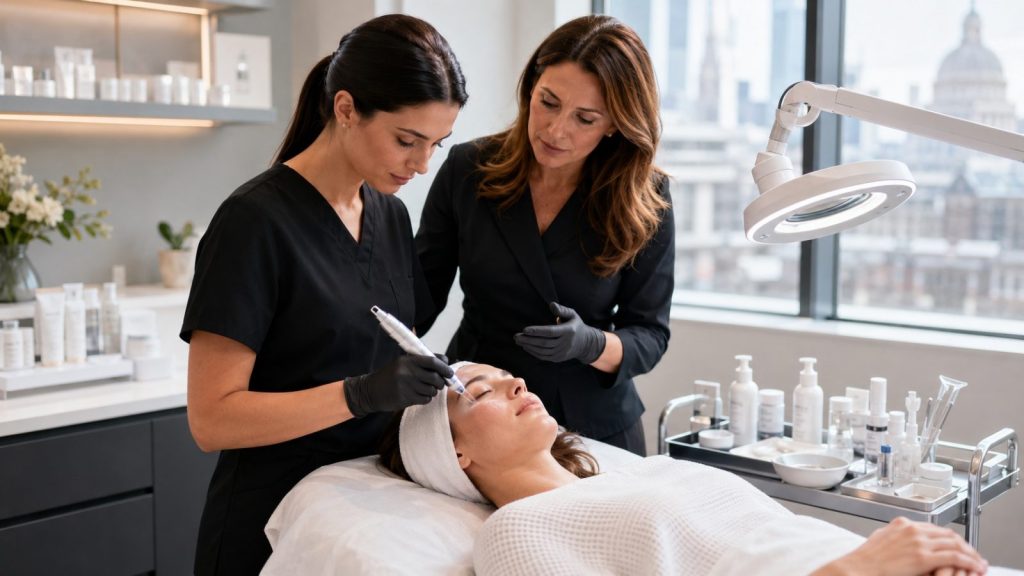
At DRV London Academy, the Level 4 aesthetics course in London combines skin science, consultation and supervised practical education in microneedling and chemical peel treatments.
What Does a Skin Specialist Do?
A skin specialist assesses a client’s skin, identifies appropriate non-surgical treatment options and develops a plan based on the individual’s needs, medical history and suitability.
The role is not simply to recommend whichever procedure is most profitable or popular.
A responsible skin practitioner should be able to:
- Conduct a structured consultation
- Review relevant medical and treatment history
- Assess skin type, condition and treatment suitability
- Identify contraindications
- Explain realistic outcomes and limitations
- Select appropriate treatment protocols
- Deliver treatments within their assessed competence
- Provide clear aftercare
- Recognise adverse responses
- Refer concerns that fall outside their professional scope
- Maintain accurate treatment records
- Follow appropriate hygiene and infection-control standards
Good skin specialist training develops judgement as well as technique. A practitioner must understand not only how a treatment is delivered, but why it may—or may not—be appropriate for a particular client.
How to Become a Skin Specialist UK
There is no single route that suits every learner.
Your starting point will depend on your previous qualifications, professional experience and the treatments you intend to offer. Someone already working in beauty therapy may have relevant practical experience, while a complete beginner may need to begin with foundation education.
A typical progression route involves the following stages.
- Establish Your Foundation Knowledge
Before moving into advanced skin procedures, learners should understand anatomy, physiology, skin science, hygiene, consultation and professional responsibilities.
Complete beginners can begin with the Level 3 aesthetics course at DRV London Academy. The Level 3 programme is designed to establish the underpinning knowledge needed before progression into more advanced aesthetics courses.
- Complete Advanced Skin Education
The next stage is a structured level 4 skin course that develops deeper scientific understanding and practical treatment skills.
Level 4 moves beyond introductory skincare. Students learn how to assess the skin more carefully, select appropriate treatments and recognise the factors that may increase treatment risk.
- Gain Supervised Practical Experience
Watching a demonstration is not the same as becoming competent.
Learners need supervised opportunities to practise consultation, preparation, treatment technique and aftercare. Feedback from an experienced tutor allows errors to be corrected before they become established habits.
- Complete the Required Assessments
A regulated qualification should require evidence of learning and practical competence.
Depending on the programme, this may involve:
- Written assignments
- Knowledge questions
- Treatment planning
- Case studies
- Practical observation
- Client records
- Reflective accounts
- A professional portfolio
- Obtain Suitable Insurance
Completing a qualification does not automatically guarantee insurance.
Practitioners should provide prospective insurers with the exact qualification title, awarding organisation, completed units and details of their practical assessment. Written confirmation should be obtained before treatments are offered commercially.
- Continue Developing Professionally
Skin treatments, products and professional standards continue to evolve. Practitioners should maintain their knowledge through ongoing education, protocol review and appropriate higher-level qualifications.
What Qualification Do You Need to Become a Skin Specialist?
The correct qualification depends on your current position and intended treatment scope.
For learners seeking advanced skin education, the ProQual Level 4 Diploma in Aesthetic Treatments and Skin Science offers a regulated pathway. ProQual describes its aesthetics suite as beginning with a knowledge-based Level 3 diploma before progressing to higher-level qualifications covering aesthetic treatments and skin science.
The exact course structure provided for DRV London Academy includes five units:
Unit Number | Unit Title | Credits |
1 | Anatomy, Physiology and Skin Science for Aesthetic Treatments | 6 |
2 | Infection Control and Health & Safety in Aesthetic Practice | 4 |
3 | Client Consultation and Assessment for Aesthetic Treatments | 4 |
4 | Skin Rejuvenation Using Microneedling | 6 |
5 | Skin Rejuvenation Using Chemical Peels | 6 |
The programme therefore combines theoretical knowledge with practical microneedling training and chemical peel training, creating the structure of a professional level 4 aesthetics course.
This is different from attending an isolated treatment workshop. The qualification links practical delivery to the science, consultation and safety principles behind the treatment.
What Will You Learn During Level 4 Skin Training?
The course develops several connected areas of competence.
Anatomy, Physiology and Skin Science
A skin practitioner must understand the tissue being treated.
Students explore areas such as:
- Skin structure and function
- The epidermis, dermis and underlying tissue
- The skin barrier
- Cellular renewal
- Collagen and elastin
- Pigmentation
- Inflammation
- Wound healing
- Age-related changes
- Common skin presentations
- Factors affecting treatment response
This knowledge helps practitioners make better treatment decisions. It also supports recognition of situations in which treatment should be postponed or declined.
Infection Control and Health and Safety
Microneedling intentionally interacts with the skin barrier, while chemical peels use controlled exfoliating agents. Poor hygiene or inappropriate protocols may expose clients to avoidable risk.
Training should therefore address:
- Hand hygiene
- Personal protective equipment
- Treatment-room preparation
- Cleaning and disinfection
- Cross-contamination prevention
- Single-use items
- Sharps handling where applicable
- Clinical waste
- Product storage
- Incident documentation
- Post-treatment hygiene
These principles are part of professional aesthetic training, not optional administrative details.
Consultation and Client Assessment
A consultation should establish whether treatment is appropriate—not merely persuade the client to book.
Students learn how to review:
- Medical history
- Medication
- Allergies
- Skin sensitivity
- Previous aesthetic treatments
- Previous adverse reactions
- Current skincare
- Recent sun exposure
- Pregnancy or breastfeeding where relevant
- Client expectations
- Contraindications
- Aftercare commitments
The practitioner should then explain the proposed treatment, expected response, limitations, alternatives and potential risks in language the client can understand.
Microneedling Training at Level 4
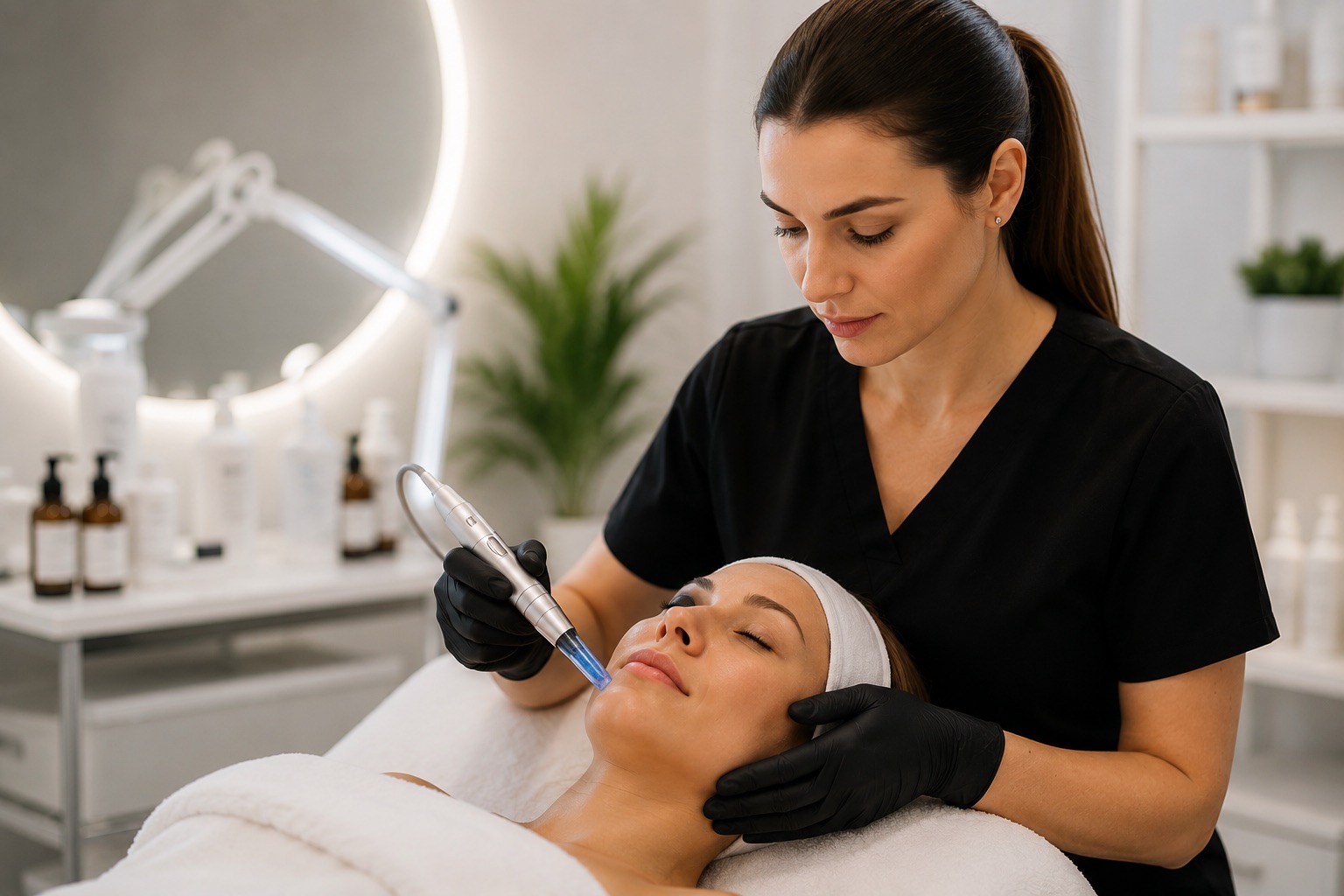
Microneedling uses a controlled needling technique to create a planned skin response. It is commonly used within appearance-focused programmes addressing concerns such as uneven texture, visible signs of ageing and certain types of scarring.
A professional microneedling course London students can rely on should cover substantially more than the operation of a device.
Level 4 microneedling training London should include:
- Client consultation
- Skin assessment
- Treatment suitability
- Contraindications
- Infection prevention
- Device and cartridge preparation
- Treatment depth considerations
- Treatment pattern and technique
- Sensitive or restricted areas
- Expected treatment response
- Aftercare
- Treatment intervals
- Record keeping
- Recognition of adverse reactions
DRV London Academy states that its Level 4 programme combines skin assessment, consultation and safe treatment protocols with structured microneedling education.
Why Microneedling Requires Proper Education
It can be tempting to view microneedling as straightforward because handheld devices are widely available. However, access to equipment does not demonstrate competence.
The practitioner must decide:
- Whether the client is suitable
- Whether the skin is healthy enough to treat
- Which areas should be avoided
- How the treatment should be adjusted
- What products may be used safely
- How to manage the immediate skin response
- When further treatment is inappropriate
These decisions require knowledge and judgement—not simply confidence with a device.
Chemical Peel Training at Level 4
Chemical peels use selected chemical agents to produce controlled exfoliation. Treatments vary considerably in formulation, strength, depth and intended outcome.
A recognised chemical peel course London should therefore teach students to evaluate the peel and the client together.
Level 4 chemical peel training London should cover:
- Skin consultation
- Relevant medical history
- Skin type and condition
- Contraindications
- Fitzpatrick skin classification
- Pigmentation considerations
- Peel ingredients
- Concentration and pH
- Product preparation
- Application technique
- Timing
- Neutralisation where required
- Expected skin response
- Aftercare
- Sun protection
- Treatment scheduling
- Adverse-response management
DRV London Academy describes chemical peel education as combining the science behind controlled exfoliation with consultation, treatment selection and safe application.
Why Peel Selection Matters
Chemical peels are not interchangeable.
A formulation that is appropriate for one client may be unsuitable for another. Skin type, sensitivity, pigmentation risk, current products, previous procedures and aftercare compliance may all influence the decision.
A trained practitioner should be prepared to recommend a different treatment—or no treatment—when the risk outweighs the likely benefit.
Microneedling Versus Chemical Peel Training
Microneedling and chemical peels are both used within skin-rejuvenation practice, but they work through different mechanisms and require different clinical decisions.
Area | Microneedling | Chemical peels |
Approach | Controlled mechanical needling | Controlled chemical exfoliation |
Main training focus | Needling technique, depth and infection prevention | Product selection, application, timing and skin response |
Skin considerations | Barrier integrity, healing and sensitivity | Skin type, pigmentation risk and product tolerance |
Aftercare | Barrier support and avoiding irritants | Sun protection, controlled recovery and avoiding irritants |
Principal risk controls | Sterility, appropriate depth and client selection | Appropriate peel choice, timing and client selection |
A combined microneedling and chemical peel course enables learners to understand two different treatment approaches rather than relying on one procedure for every client.
The objective is not to perform both treatments on everyone. It is to understand when each treatment may be appropriate and when it should be avoided.
Can Non-Medics Become Skin Specialists?
Non-medical practitioners may pursue skin-focused qualifications when they satisfy the programme’s entry requirements and remain within the limits of their education, competence and insurance.
Being a non-medic does not remove the need for:
- Anatomy and physiology knowledge
- Safe consultation
- Practical assessment
- Infection-control competence
- Clear referral boundaries
- Appropriate insurance
- Continued professional development
It is also important not to imply medical registration that the practitioner does not hold.
A skin-focused practitioner can build credibility through accurate communication, responsible treatment selection and verifiable qualifications—not through adopting titles or claims that misrepresent their professional status.
Is Level 4 Enough to Work as a Skin Specialist?
Level 4 can provide an important qualification for advanced skin practice, particularly where learners have completed and passed the relevant practical units.
However, professional readiness depends on more than the certificate itself.
Before treating clients independently, graduates should confirm that:
- They have completed all required assessments
- The intended procedure was included within their qualification
- They can demonstrate practical competence
- Their insurer has approved the treatment
- Their premises are appropriate
- Infection-control arrangements are established
- Consultation and consent documents are suitable
- Emergency and adverse-event protocols are available
- Products and equipment are being used according to instructions
- They understand when referral is required
Competence grows through practice, reflection and continued education. A qualification provides a framework, but professional development must continue after graduation.
Can You Start a Skin Clinic After Level 4?
Some Level 4 graduates use their qualification to begin offering insured skin treatments independently, while others initially work within an established salon or clinic.
Opening a practice requires additional preparation beyond treatment skill.
You may need to consider:
- Business registration
- Professional indemnity and public liability insurance
- Premises suitability
- Local authority requirements
- Waste contracts
- Infection-control policies
- Client records
- Privacy and data protection
- Consent documentation
- Product and equipment compliance
- Complaints procedures
- Marketing claims
- Financial planning
- Referral relationships
Beginning within an existing clinic may allow a new practitioner to gain additional experience before assuming full responsibility for an independent business.
How to Choose Between Skin Specialist Courses
Not all skin specialist courses offer the same qualification, content or practical experience.
Before enrolling, ask the provider the following questions.
What Is the Exact Qualification?
Request:
- The full qualification title
- Awarding organisation
- Qualification number
- Regulated level
- Unit titles
- Credit values
For the programme discussed here, the official qualification is the ProQual Level 4 Diploma in Aesthetic Treatments and Skin Science, qualification number 610/4475/1.
What Practical Treatments Are Included?
Do not assume every treatment mentioned on a general website is included in your individual programme.
Obtain written confirmation of the units, practical sessions, models and assessments included in the skin specialist course you are booking.
How Is Competence Assessed?
Ask whether practical assessment takes place on live models, how many treatments are required and what happens when a learner needs further practice.
Who Delivers the Training?
Tutors should combine relevant subject experience with appropriate teaching and assessment competence.
Is the Qualification Accepted by Insurers?
Speak directly with insurers. Provide the complete qualification and unit information rather than relying only on the academy’s general assurances.
What Progression Is Available?
A good academy should explain what Level 4 supports, what remains outside the qualification and which higher-level courses may be appropriate next.
Why Choose DRV London Academy for Your Aesthetic Training?
DRV London Academy offers aesthetic training London learners can access from its central Baker Street location.
The academy’s Level 4 aesthetics programme focuses on:
- Skin science
- Consultation and client assessment
- Infection control
- Microneedling
- Chemical peels
- Practical learning
- Professional treatment planning
- Continued progression
Students comparing a level 4 beauty course London should look beyond course duration and price. The more important questions concern the qualification, practical assessment, tutor guidance and the professional pathway available after completion.
DRV London Academy promotes small-group education, hands-on learning and guidance from practitioners working within the aesthetics sector.
Its Baker Street location also makes the level 4 aesthetics course London accessible to learners travelling from across central, north, west and south London.
What Can You Study After Level 4?
Level 4 can act as a foundation for deeper skin education and more advanced aesthetic practice.
Level 5 Aesthetic Practice
The Level 5 aesthetics course in London supports learners seeking to develop more advanced assessment, skin knowledge and professional decision-making.
Level 6 Aesthetic Practice
The Level 6 aesthetics diploma is intended for practitioners progressing towards higher-level aesthetic procedures and clinical knowledge.
Entry requirements should be checked carefully before enrolment.
Level 7 Aesthetic Practice
Experienced practitioners may later progress to the Level 7 aesthetics diploma in London.
Level 7 represents advanced study and should not be treated as a substitute for the knowledge and practical development established at earlier levels.
The correct pathway is not necessarily the shortest. It is the route that allows competence to develop safely and progressively.
Frequently Asked Questions
Begin with the appropriate foundation qualification, progress into advanced skin science and practical treatment education, complete supervised assessments and obtain suitable insurance. The precise route depends on your existing qualifications and intended treatments.
The ProQual Level 4 Diploma in Aesthetic Treatments and Skin Science offers a regulated route covering skin science, consultation, infection control, microneedling and chemical peels within the course structure supplied by DRV London Academy.
Yes. Skin Rejuvenation Using Microneedling is included within the five-unit structure supplied for the programme. Students should complete the practical assessment and confirm insurance before offering treatment professionally.
Yes. Skin Rejuvenation Using Chemical Peels is included within the supplied Level 4 structure. Training covers treatment selection, safe delivery, client suitability and aftercare.
The ProQual Level 4 Diploma in Aesthetic Treatments and Skin Science is an Ofqual-regulated qualification on the Regulated Qualifications Framework. Its qualification number is 610/4475/1.
Eligible non-medical applicants may take Level 4 when they meet the relevant entry requirements. Complete beginners who lack the required foundation may need to complete Level 3 first.
Some graduates may establish an insured skin-treatment practice after completing the relevant units and assessments. They must also address business, premises, insurance, hygiene, documentation and applicable regulatory requirements.
Theory can be delivered online, but practical treatments require supervised learning and assessment. A video demonstration cannot independently establish treatment competence.
Begin Your Skin Specialist Training in London
Becoming a respected skin practitioner is not about learning the greatest number of treatments in the shortest possible time.
It is about understanding the skin, selecting clients responsibly and delivering treatments within a clearly defined scope of competence.
The DRV London Academy Level 4 aesthetics course combines skin science, client assessment, microneedling training and chemical peel training within a structured professional pathway.
Students who need foundation knowledge can begin with the Level 3 aesthetics course before progressing.
To discuss eligibility, upcoming course dates and practical training, contact DRV London Academy on +44 7539 006999.