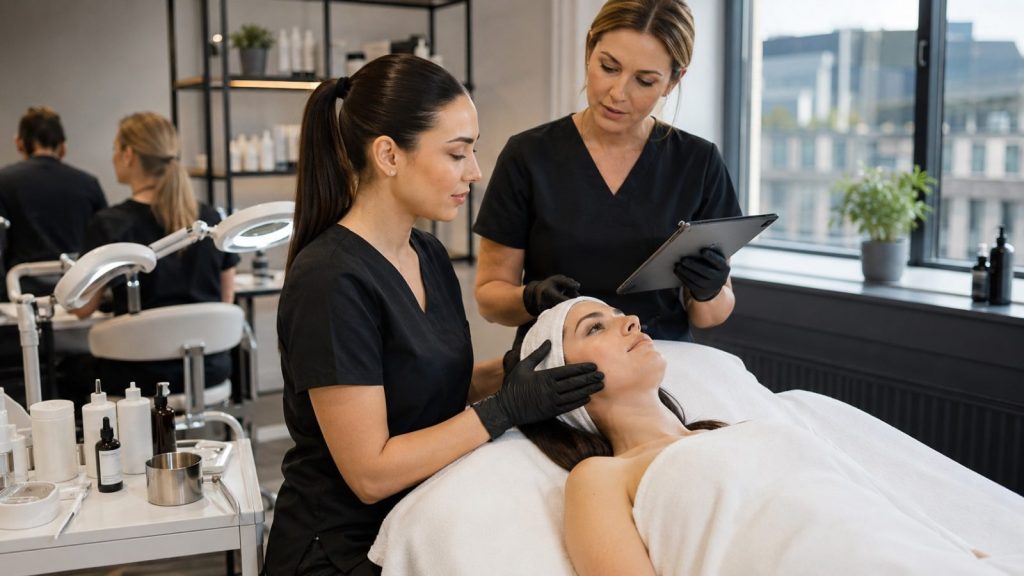
The question of how to become an aesthetic practitioner is rarely answered well.
Some advice makes the process appear effortless: complete a short course, receive a certificate and immediately begin offering treatments. Other guidance makes aesthetics seem inaccessible unless you already hold a medical degree. Neither version reflects the full picture.
Building a credible career in aesthetics requires more than learning how to perform a procedure. You need a sound understanding of skin, anatomy, hygiene, consultation, client suitability, contraindications, aftercare and professional responsibility. You must also select qualifications that match your current experience and the treatments you eventually want to provide.
For beginners in London, a structured Level 3 qualification can provide the foundation from which that progression begins.
At DRV London Academy, the Level 3 aesthetic course in London is designed for learners taking their first formal step into professional aesthetic practice. The course combines theoretical education, practical experience and assessed learning, helping students build the knowledge required before moving towards higher-level treatments.
How to Become an Aesthetic Practitioner UK: The Basic Pathway
Anyone researching how to become an aesthetic practitioner UK should begin by understanding that there is no single training route suitable for every learner.
Your route will depend on:
- Your existing qualifications and professional background
- Whether you are a complete beginner or an experienced beauty practitioner
- The treatments you want to perform
- The entry requirements of each qualification
- The requirements of your prospective insurer
- Any professional, local authority or regulatory obligations
- Whether prescribing or clinical oversight is necessary
The Government has committed to developing a licensing framework for specified non-surgical cosmetic procedures in England. The intended scheme is expected to involve practitioner and premises licensing, appropriate training, recognised qualifications, indemnity cover and standards relating to hygiene and infection control. However, the detailed licensing regulations have not yet completed the parliamentary process.
This means aspiring practitioners should avoid relying on claims that one certificate automatically grants unrestricted authority to perform every procedure. Instead, the safer and more professional approach is to build your education progressively.
A typical route may involve:
- Completing an appropriate foundation qualification
- Developing knowledge of skin, anatomy and safe practice
- Gaining supervised practical experience
- Progressing into treatment-specific qualifications
- Obtaining appropriate professional insurance
- Working within the scope of your training and competence
- Continuing your education as techniques and standards evolve
The objective is not simply to collect certificates. It is to become a knowledgeable, responsible and clinically aware practitioner.
Can You Become an Aesthetic Practitioner Without a Degree?
One of the most common searches is how to become an aesthetic practitioner without a degree.
A university degree is not the only possible starting point for every area of aesthetics. Learners from non-medical backgrounds may be able to enter through recognised vocational qualifications, beginning with foundation-level skin and aesthetic training.
However, being able to enrol on a course does not mean that every learner can immediately perform every treatment.
Certain procedures require more advanced training, greater anatomical knowledge, treatment-specific practical assessment, suitable insurance and, in some circumstances, involvement from a regulated healthcare professional. Prescription-only medicines also require lawful prescribing arrangements.
A responsible training provider should therefore assess where you are beginning, explain what the qualification covers and tell you what further training will be required.
At DRV London Academy, the Level 3 programme is positioned as a starting point rather than a shortcut into advanced injectable practice.
Can Non-Medics Train in Aesthetics?
Yes, non-medics can study certain areas of aesthetics, provided they select training appropriate to their background and intended scope of practice.
The phrase aesthetic courses London for non medics covers a broad range of programmes. Some focus on foundational skin knowledge, while others advertise advanced procedures. These courses should not be treated as interchangeable.
Before selecting a non medic aesthetics course, ask:
- Is the qualification regulated or independently accredited?
- What is the exact qualification title?
- Which awarding organisation issues it?
- What prior qualifications are required?
- Does the course include supervised practical assessment?
- Which treatments does the programme genuinely cover?
- Will insurers recognise the qualification for the intended treatment?
- What further training will be needed after completion?
- Does the course make claims that appear unrealistic or legally misleading?
A complete beginner should be particularly cautious about courses promising several advanced procedures in one or two days. Aesthetics involves treating real people, managing clinical risk and recognising when treatment should not proceed. Speed should never replace competence.
Why Begin with a Level 3 Aesthetics Course?
The ProQual Level 3 Diploma in Pathway to Aesthetic Practice is a regulated qualification listed under qualification number 610/4465/9. ProQual also offers a structured suite of aesthetic practice qualifications at Levels 4, 5, 6 and 7.
A level 3 aesthetics course can help a beginner develop the underpinning knowledge needed to approach the profession responsibly.
At DRV London Academy, the Level 3 programme covers foundational subjects including:
- Health, safety and hygiene in aesthetic practice
- Infection prevention and safe working procedures
- Skin anatomy and physiology
- Client consultation
- Medical history and suitability assessment
- Treatment planning
- Contraindications and contra-actions
- Aftercare
- Professional and ethical practice
These subjects may not appear as exciting as learning a fashionable treatment technique, but they influence every client interaction.
A practitioner must know how to take an appropriate history, identify potential risks, manage expectations and recognise when a client should not be treated. Technical ability without judgement is not enough.
What Should a Beginner Aesthetics Course Include?
A suitable beginner aesthetics course should develop knowledge and professional behaviour—not merely demonstrate a sequence of treatment steps.
Look for a programme that includes:
Skin and Anatomy Knowledge
Students should understand the structure and functions of the skin, common conditions and the way different treatments interact with tissue.
Health, Hygiene and Infection Prevention
Training should address hand hygiene, personal protective equipment, decontamination, waste management, safe treatment environments and the prevention of cross-contamination.
Consultation and Client Assessment
A proper consultation involves more than asking what result the client wants. Practitioners must gather relevant information, identify contraindications, assess suitability and explain realistic outcomes.
Consent and Expectation Management
Clients should understand what a procedure involves, its limitations, possible side effects, aftercare requirements and alternative options.
Supervised Practical Learning
Practical confidence develops through observation, guided participation, feedback and assessment. A course based entirely on unsupervised online learning may not provide the clinical experience required for practical treatments.
Professional Responsibility
Students should understand the limits of their competence. Knowing when to decline, refer or seek additional advice is a mark of professionalism—not weakness.
How Long Does It Take to Become an Aesthetic Practitioner?
There is no universal timeframe.
The answer depends on your starting point, chosen qualification and long-term treatment goals. Someone beginning with no formal experience may require a staged pathway, while an established healthcare or beauty professional may already meet some entry requirements.
Be cautious about providers suggesting that an entire professional career can be built through a single weekend.
When comparing aesthetic training courses London, consider:
- Total learning time
- Guided teaching hours
- Practical training
- Live-model experience
- Assessment requirements
- Portfolio or coursework requirements
- Tutor access
- Post-course support
- Progression opportunities
The shortest programme is not necessarily the most efficient. Repeating inadequate training, correcting unsafe habits or discovering that an insurer will not accept a certificate can cost considerably more than selecting the correct pathway from the beginning.
The Qualification Pathway from Level 3 to Level 7
A structured pathway allows learners to build knowledge in stages, with each qualification supporting more advanced study.
Level 3: Establishing Your Foundation
The Level 3 aesthetic course at DRV London Academy is designed for beginners who need foundational education in skin, consultation, hygiene and professional practice.
It is suitable for learners searching for aesthetic courses for beginners London rather than an isolated treatment workshop.
The programme fee currently listed by DRV London Academy is £2,500, including theoretical learning, practical training, live-model sessions, course materials, assessments and certification. A £500 deposit is required to reserve a place, and prospective students should confirm current fees directly before enrolling.
Level 4: Developing Practical Skin-Treatment Skills
After completing the appropriate foundation training, students may progress to the Level 4 aesthetics course in London.
Level 4 develops more advanced knowledge of skin science, consultation, treatment planning and professional skin treatments. The DRV London Academy programme includes practical education connected with microneedling and chemical peel treatments.
At this stage, learners begin moving beyond introductory theory and develop greater confidence in assessing the skin and delivering appropriate treatments.
Level 5: Advancing Skin Knowledge
The Level 5 aesthetics course in London is intended for practitioners who already possess relevant foundational knowledge and want to deepen their clinical judgement.
The course develops the learner’s understanding of treatment selection, skin response, treatment adaptation and professional decision-making. Rather than simply repeating procedures, students learn to consider why a treatment is appropriate and how it should be adjusted for different clients.
Level 6: Moving into Advanced Aesthetic Practice
The Level 6 aesthetics course in London is designed for experienced practitioners progressing towards advanced clinical practice.
The programme focuses on higher-level consultation, treatment planning, anatomy, professional practice and practical competence. It is not positioned as an entry-level course, so applicants should confirm that they satisfy the relevant prerequisites before applying.
Level 7: Advanced Injectable Training
The Level 7 aesthetics diploma in London is an advanced programme for practitioners ready to develop their knowledge of injectable treatments, ethics, consultation, clinical decision-making and complications management.
Students interested in specialist thread procedures can also explore the Level 7 PDO thread aesthetics course, which covers advanced thread techniques, consultation, treatment planning, safety and practical work on live models.
Not every learner will need every qualification. The correct route must be based on previous education, professional background, intended procedures and programme entry requirements.
How to Choose Between Aesthetic Courses in London
Searching for aesthetic courses London produces hundreds of options, from short workshops to regulated qualifications.
Price and duration matter, but they should not be the only deciding factors.
Before choosing an aesthetics course London, investigate:
The Qualification
Ask for the exact title, level, awarding organisation and qualification number. The provider should be able to explain whether the course leads to a regulated qualification or an independently issued certificate.
The Tutors
Experienced tutors should be able to connect theory with real clinical situations. They should understand consultation, client selection, complications, aftercare and professional boundaries—not just demonstrate treatment technique.
Practical Training
Find out how much supervised practical experience is included, whether live models are available and how competence is assessed.
Class Size
Smaller groups can give students more opportunities to ask questions, receive feedback and practise under supervision.
Progression
A strong aesthetic practitioner course London learners can trust should explain what comes next. It should not leave graduates with a certificate but no understanding of their professional pathway.
Ongoing Support
Early-career practitioners often need guidance after completing their course. Access to tutors, mentoring, observation opportunities and a professional network can help students continue developing safely.
Why Study Aesthetics in London?
London provides access to a large, diverse aesthetics market and a wide range of professional training environments.
Students looking for aesthetics training London may benefit from exposure to experienced practitioners, live models and different client needs. However, location alone does not guarantee course quality.
DRV London Academy is based at 1st Floor, 136 Baker Street, London W1U 6UE. Its central location makes the academy accessible to learners travelling from across London and surrounding areas. The academy offers practical training, live-model experience and a progression pathway from Level 3 towards advanced qualifications.
When comparing aesthetic courses London, consider the complete student experience:
- Is the location accessible?
- Is the training delivered in an appropriate professional environment?
- Will you receive practical supervision?
- Are the course outcomes explained clearly?
- Is support available after training?
- Can the academy support your future progression?
The right academy should help you understand both what you can do after qualifying and what remains outside your current competence.
What Can You Do After Completing Level 3?
Completing Level 3 is an educational milestone, but it should not be presented as the end of your training.
Depending on the units completed, your prior background and your insurance arrangements, the qualification may support progression into:
- Level 4 skin and aesthetic training
- More advanced skin-treatment qualifications
- Supervised clinic experience
- Roles within suitable beauty or aesthetic environments
- Further study towards Levels 5, 6 and 7
- Additional treatment-specific education
Before offering any treatment independently, confirm that:
- The procedure was included within your assessed training
- You can demonstrate practical competence
- Your insurer has agreed to provide appropriate cover
- Your premises and infection-control arrangements are suitable
- You understand the treatment’s contraindications and complications
- You are working within all applicable legal and professional requirements
A responsible career is built one competent step at a time.
Frequently Asked Questions
The most appropriate course is one that matches your existing qualifications and future plans. For complete beginners, a regulated foundation programme covering skin, hygiene, consultation and safe professional practice may be more appropriate than an advanced treatment workshop.
Non-medics can study certain aesthetic qualifications and skin treatments. However, eligibility varies between programmes, treatments and insurers. Advanced procedures may require additional qualifications, clinical oversight or regulated healthcare status.
DRV London Academy describes its Level 3 course as a beginner pathway. Applicants should still contact the admissions team to confirm suitability and discuss their intended progression route.
Level 3 alone should not be treated as an injectable qualification. Injectable treatments require additional treatment-specific education, practical assessment, anatomy knowledge, complications training and appropriate insurance.
Fees differ according to the qualification level, practical content, duration and assessment requirements. DRV London Academy currently lists its Level 3 course at £2,500, with a £500 deposit required to secure a place. Confirm the latest fee and payment arrangements with the academy before enrolment.
DRV London Academy provides a structured training pathway from Level 3 through to advanced Level 7 qualifications from its academy on Baker Street in central London.
Begin Your Aesthetics Career with the Right Foundation
Learning how to become an aesthetic practitioner is not about finding the fastest certificate. It is about selecting a pathway that allows you to develop knowledge, judgement and practical confidence at the correct pace.
The profession involves real responsibility. Every consultation, treatment plan and aftercare decision can affect a client’s wellbeing. That is why foundation education matters.
For learners comparing a beginner aesthetics course, the DRV London Academy Level 3 programme offers a structured entry point supported by practical training and a clear pathway towards higher qualifications.
Explore the Level 3 aesthetic course in London or contact the DRV London Academy admissions team on +44 7539 006999 to discuss eligibility, upcoming course dates and your professional goals.